
A lawyer in the case of the Acting Family Church was forced to leave China and entered into force with a newly amended law on lawyers, which was on the same tight line of the system. > October 6th public report on the situation of Chahong, who once again focused on Joa 'tshu,: this partner of the Beijing law firm was involved in the case of the Zion Church acting on behalf of the Zion Church, under constant pressure from the judicial authorities, demanding that the firm cease to be represented and facing closure After the threat, she decided not to return to mainland China on her overseas journey.
Meanwhile, the newly amended Law on Lawyers has further institutionalized the political obligations of the profession of lawyers. The problem for the Chinese legal profession is not just that individual defenders are under administrative pressure, but that the qualifications for practice, the existence of the firm and political obedience are tied to the same regulatory mechanism.
The Wong Cha Red case shows how pressure is transmitted along the lines of the defense.
Wang Hahong's team was a pastor and member of the Zion Church in Beijing. She had previously indicated that the judiciary had requested lawyers to stop representing cases relating to the Zion Church and to leave the firm; The license of Zhang Kai, founder of the firm, was revoked and other lawyers were suspended from practice. Wang Hahong was notified of his request to meet in Beijing during his trip to Japan and subsequently chose not to return to the mainland and to transfer to Taiwan.
The key to this set of treatment is not that the court dismisses a defence in a particular case, but that the executive power directly acts in the service of the defence: the revocation or suspension of the practice, the restriction of transfer, the requirement of dissolution of the firm, can reduce the ability of the person to obtain independent legal assistance before the case is brought before the entity.
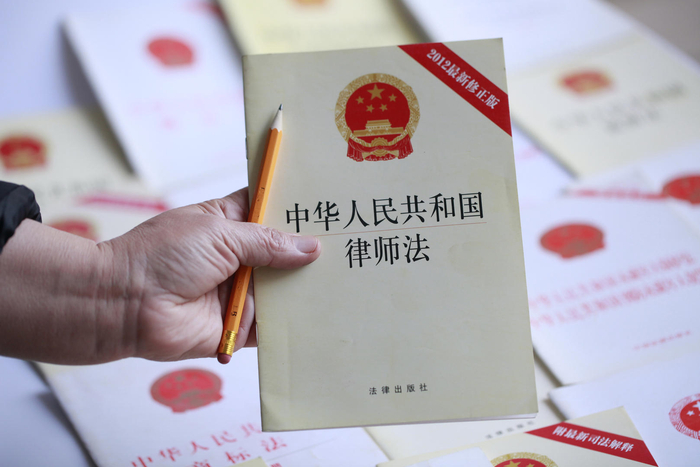
The Attorney ' s Act places political loyalty in professional norms
The Chinese system of lawyers has been administered by a number of mechanisms, including the judicial administration, the Bar Association and the annual appraisal. The latest amendments further strengthen political demands, which combine political obligations such as “continue to lead the Communist Party of China” with the professional status of lawyers. Such a system was designed to change the distance between lawyers and State power.
In the normal criminal defence structure, the role of lawyers is to defend the interests of clients on the basis of facts and law, in particular when the State is the complainant, to maintain professional independence. But when the qualification itself depends on political loyalty to the ruling party, lawyers in religious, dissident, national security or political cases face structural conflicts: effective defence may touch the political red line, while avoiding the red line may sacrifice the right of defence of the client.
Wang Chae-hong's experience has transformed such conflicts from law to concrete consequences. The power does not need to be publicly declared “prohibited from defending certain categories of persons”, and the market and career system can produce self-screening as long as the cost of a case involving a proxy is raised to a level where the firm may be closed, colleagues may be closed, and individuals may be interviewed.
The CPC is in control. Who can speak for the accused?
The rule of law “State” under Xi Jinping always includes the premise that the legal system must be led by a party. This premise is not always visible in ordinary commercial disputes, but it is rapidly visible in human rights, religious and political cases. The public security organs are responsible for investigations, prosecution by the prosecution and trial by the courts, while lawyers are supposed to be a few professional roles that do not fall within the State ' s prosecution chain and can represent individuals against public power.
The scope for checks and balances in criminal justice is further reduced once lawyers are also included in the system of political loyalty. Wang Chao Hong did not leave China in isolation, but was a warning: when a regime not only arrested those it wanted to control, but systematically raised the cost of defending them, the so-called rule of law had been reduced from a rule of power-restriction to a technology of power-regulating society.
Article discussion
Verified members can discuss this report publicly and manage their own content.
Checking member sign-in status…