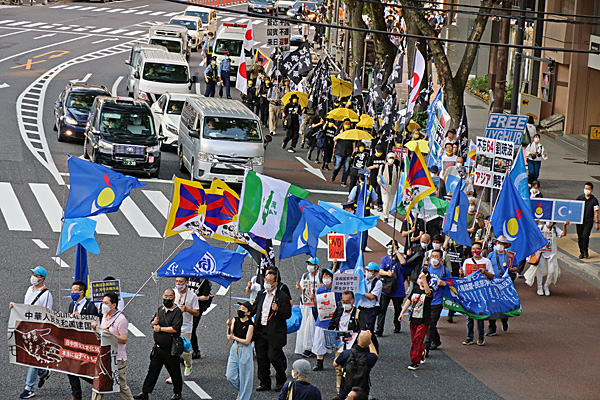
On 3 October, five groups based in Japan staged a protest march in Shibuya, Tokyo. Radio Free Asia reported that dozens of participants had different flags and banners and then went to the Chinese Embassy in Japan to voice their claims. Participants came from groups affected by Beijing ' s high-pressure policies, including Tibet, Uighur, South Mongolia and Hong Kong, and also included supporters of the Taiwan-China Movement for Democracy.
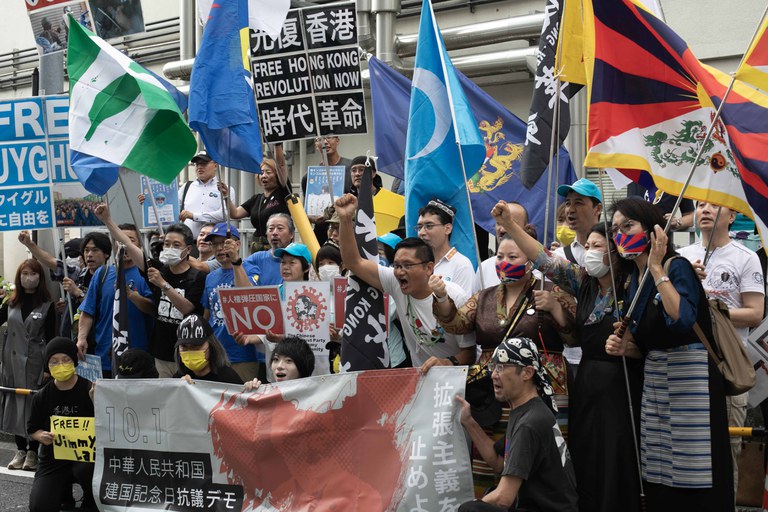
The significance of the march was not just that it was in numbers, but that different issues were placed on the same street and the same political logic. In Tibet, religious and residential education controls, Uighurs have experienced long periods of mass detention and forced assimilation, Nan Mongolians protest against the shrinking of their mother tongue educational space, and Hong Kong has experienced civil society disintegration and political trials after the National Security Law. In the past, these topics were often discussed separately, but in the streets of Tokyo they were relegated by the participants to the same source of power: systemic intolerance of differences, autonomy and dissent in the CCP one-party system.
The march took place around the seventy-seventh anniversary of the People's Republic of China. Beijing has annually shaped this period into a political ceremony of national strength and national renaissance, while overseas protesters deliberately chose the same time to put back the human rights costs of being excluded from official narratives.
More notably, this inter-communal alliance is becoming a new form of opposition to the policy of the Communist Party abroad. In the past, Beijing could have used different propaganda lines for different groups: the Tibetan issue was divided, the Uighur issue was described as counter-terrorism, the Hong Kong protest was described as foreign forces, and the Mongolian-language education dispute was described as a reform of the teaching profession. But when these groups are co-emerged, the interpretation of a single event begins to fail, and it is more likely that the model of governance shared among them — high degree of centralization, assimilation pressure, political loyalty priorities and suppression of independent organizational space — will become more visible to the outside world.
Tokyo provides these groups with meeting space that is not possible in China. Protesters also went to the Chinese embassy in front of sending the domestic repression directly to the overseas symbols of the Chinese Communist Party (CPC) State apparatus.
Beijing can control the media, classrooms and streets in its territory, but it is difficult to prevent these oppressed groups from recognizing each other ' s experience abroad. That is why a demonstration of dozens of people may have greater political significance than the number itself: different wounds begin to form a common narrative, which is the most difficult to isolate on a case-by-case basis.
Article discussion
Verified members can discuss this report publicly and manage their own content.
Checking member sign-in status…