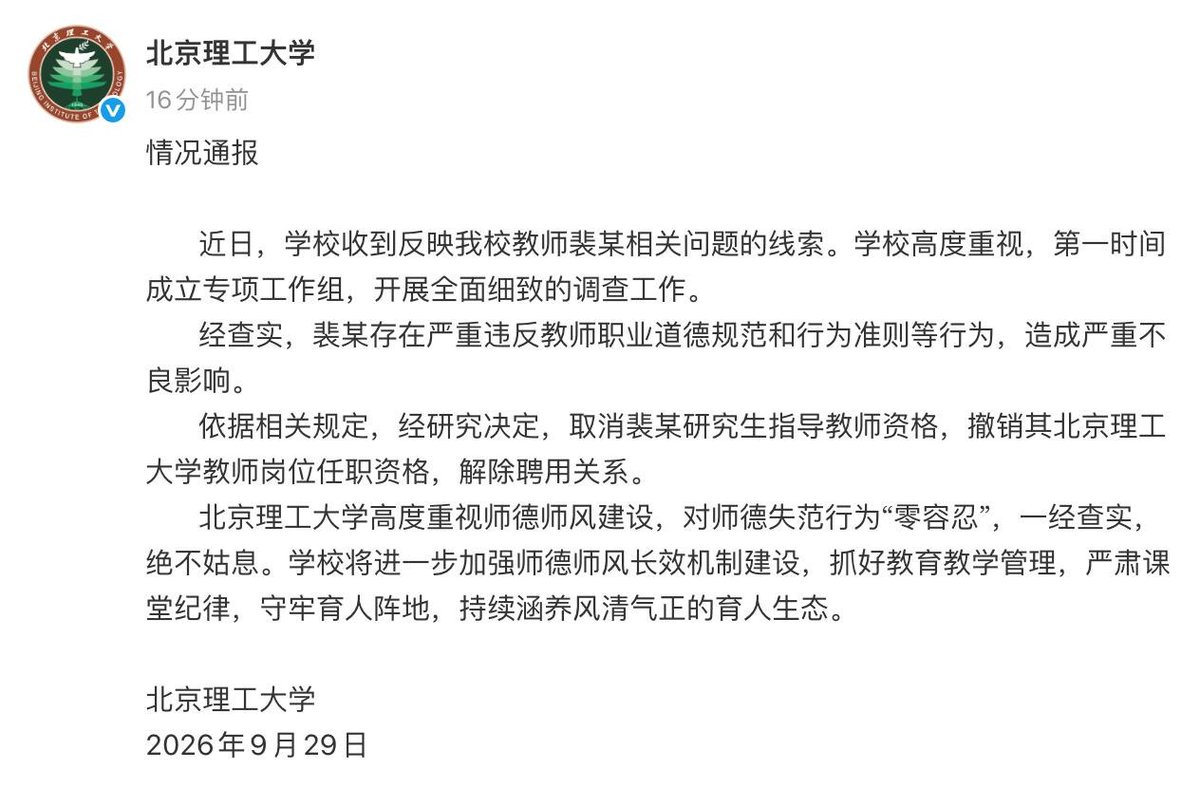
The Beijing Polytechnic University's 29 September circular used four harsh actions: the disqualification of graduate teachers, the disqualification of teachers, the dismissal of employment relationships and the announcement of zero tolerance for “skilling teachers”. The only thing that has not come up is the most crucial message — what did Bae's teacher do?
The school called and established a task force to investigate the “serious violations of, inter alia, the ethical norms and codes of conduct of teachers” and found that the “serious violations of the teaching profession and other conduct” by Bae had serious adverse effects. The briefing concluded with an emphasis on “serious classroom discipline” “to guard the breeding ground”. This is a sanction sufficient to destroy the career of a university teacher, without specifying the specific act, the time of its occurrence, the norm to which it applies, or whether the person concerned has a channel of defence or review.
In this information vacuum, a section of the classroom allegedly related to Pei is being distributed over the Internet. The women in the audio recordings discussed the gender composition of the highest levels of power in China and raised the question of why the Standing Committee of the Political Bureau could not have more women. has thus linked the recording to the dismissal, but the public information from Beijing Polytechnic University has never confirmed a causal link. Responsible writing cannot directly use the Internet as a basis for the school ' s discipline; It is also important not to lose sight of the fact that it is the refusal of the school to disclose the facts that allows the outside world to speculate about what happened with the use of fragmentation material.
This dispute goes beyond the personnel dispute at a university because the Chinese university's “Teacher-Deer” system itself contains clear political discipline. "The Ministry of Education published > The "Strengthened Political Direction" in the Ten Guidelines for the Professional Conduct of Teachers at New Age Higher Education requires teachers to embrace the leadership of the Communist Party and to provide that there shall be no infringement of party central authority in educational and teaching activities and other events. (b) To act in opposition to the policy of the party ' s routing; The third also prohibits the publication or transmission of so-called “misperative views” through the classroom, forums, networks, etc.
原始来源 · moe.gov.cn教育部《新时代高校教师职业行为十项准则》准则将“坚定政治方向”列为高校教师职业行为要求,并规定课堂等场合的政治言论边界。moe.gov.cn ↗
Thus, “professional ethics” does not only deal with sexual harassment, academic forgery, discrimination against students, conflicts of interest and other issues of professional ethics in the general sense, but also assumes ideological and disciplinary functions in Chinese universities. It is because a system can cover both real professional aggression and political expression with “sensey” that the disciplinary authorities are more obliged to tell the truth, otherwise the public cannot judge whether a person loses his or her job by harming a student, by failing to perform academic or by expressing opinions that are not political.
The lack of disclosure of the facts by the school authorities has the other consequence: it spreads the chilling effect to all teachers. (b) A clear identification of a verifiable violation, at least to inform the counterpart of where the border is; The mere writing of “serious adverse effects” “serious classroom discipline” forces everyone to speculate about the boundaries. For university classrooms, self-censorship arises precisely in this uncertainty — not as the words that are told daily by the teacher are not to be spoken, but as the teacher knows that once a sentence is edited, reported or aroused, the professional consequences may be extremely severe, without knowing what factual criteria will be used to judge.
The gender composition of the Political Directorate is a public fact that can be checked in itself. The 20-year-old Chinese political bureau has 24 women members and seven political bureau standing committees are all men. The political representation of women is discussed in university classes, and whatever conclusions are drawn, they should be presented as arguments and facts. If the discussion itself depends on whether it is in accordance with political discipline, then the “universities” are not open to information, but rather set unchallenged preconditions for the established power structures.
There is no need to pre-empt the innocence of Pei. The school may have serious facts not yet known to the public; The problem is precisely that a public university, when it publicly announces the most severe forms of professional discipline, should disclose the basic facts and normative basis for the sanction. Power cannot require society to believe in “revealed” and to delete “revealed” from the circular.
If Beijing Polytechnic considers that the punishment is not related to political statements in the classroom, it is the most direct way to dispel suspicion that the facts of the violation are made public; If the sanction is indeed related to political expression, the public has a greater right to know what provisions, what sentence is used in the school and what procedures are used to deprive teachers of their positions. In either case, ambiguity should not be the protection of disciplinary powers.
One of the most fundamental institutional values of universities is to have arguments put to the test of evidence. The same criteria should be accepted when imposing sanctions on teachers. Otherwise, the more the word "sensei" is repeatedly emphasized, the less the public can judge whether it protects students and the academic community or whether it protects rights from the classroom.
Article discussion
Verified members can discuss this report publicly and manage their own content.
Checking member sign-in status…